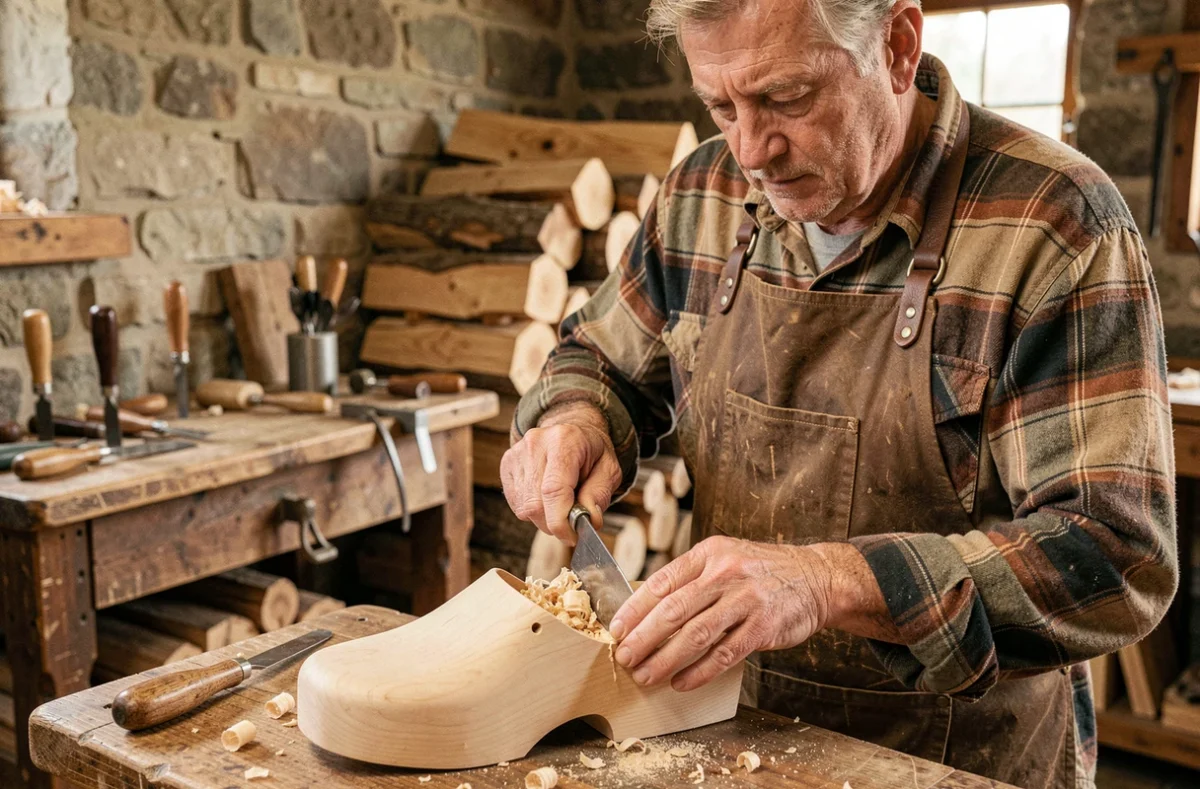
A clog carved from poplar does not behave at all like a beech clog. The weight, moisture resistance, ease of carving, and lifespan change radically from one species to another. Understanding these differences allows for the selection of a pair suited to its use, whether for gardening, outdoor work, or decoration.
Drying and preparing the wood before carving the clog
Before even discussing species, one technical point determines the final quality: the drying of the wood is as crucial as the species itself. A perfectly dried birch will yield a more stable clog than a beech that has been worked while still too green.
The clog maker traditionally works with wood that is “half-dry.” If too moist, the block deforms after carving, and the clog splits as it dries. If too dry, it becomes brittle under the chisel and cracks at the slightest impact.
The drying time varies depending on the species. Softwoods like poplar lose their moisture faster than beech, whose density slows down evaporation. Artisans store their logs for several months, sometimes longer, before cutting them into billets. This delay is an integral part of the craftsmanship, even if it never appears on the finished product.
To delve deeper into the question of wood used for clogs, it is essential to keep in mind that preparation is as important as the choice of tree.
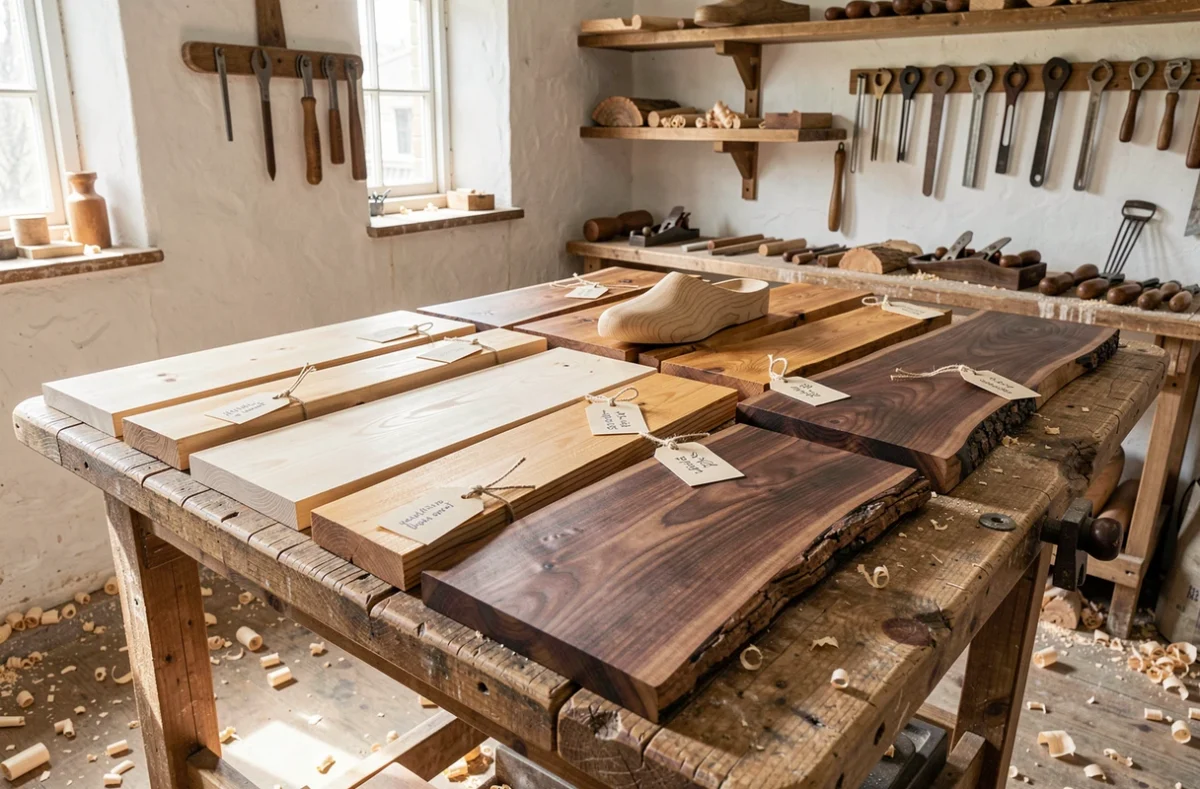
Beech, birch, poplar: three species of clogs with distinct uses
You may have noticed that some clogs appear heavy and massive, while others seem almost light? This is not a matter of size, but of species.
Beech, the hard wood of mountainous regions
Beech is the most wear-resistant clog wood. Used in Brittany, the Belgian Ardennes, and eastern France, it produces a solid, dense clog that withstands rocky terrain. Its hardness has a downside: the clog is heavier. In the Belgian Ardennes, artisans compensated for this weight by carving open clogs, with the instep exposed, and thinning the walls.
Poplar, light but fragile
Poplar is a soft and lightweight wood, very common in the French plains. It carves easily, making it accessible to clog makers working in large quantities. In return, poplar clogs wear out faster and were sometimes shod to extend their lifespan. However, Loire riverboatmen appreciated them, as poplar and willow provided a less slippery sole on wet decks.
Birch, the compromise of the plains
Birch lies between the two. Harder than poplar, less dense than beech, it was widely used in the plains of France. Its availability made it a pragmatic choice for itinerant clog makers who settled close to local forests.
Other species appear depending on the regions: pine, fir, alder. Each responded to a logic of geographical proximity before being a technical choice.
- Beech is suitable for difficult terrain and intensive use, with a higher weight.
- Poplar favors lightness and ease of carving, at the cost of faster wear.
- Birch offers a balance between resistance and availability in plain areas.
- Willow and alder complement the palette according to local forest resources.
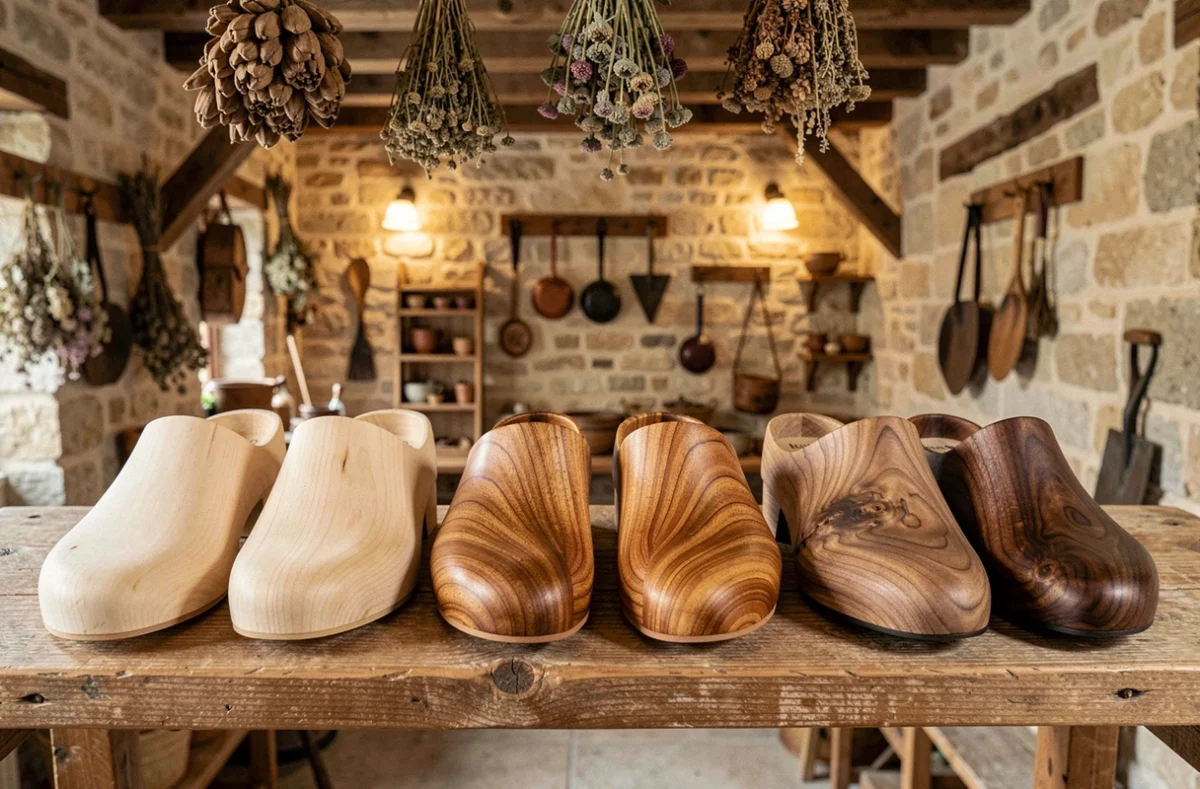
Traceability of clog wood: what labels really guarantee
When a workshop claims to make clogs from “French wood,” it does not automatically mean that the tree grew, was cut, and processed in the same region. The origin of the wood and the place of manufacture are two distinct criteria.
The stages of transport and initial processing can distance the log from its harvesting location. A clog maker based in the southwest could very well work with beech cut in the Grand Est, without this being mentioned.
The Bois de France label, created in 2020, aims specifically to certify the origin and traceability of woods collected and processed on the territory. Since 2024, organizations like Control Union conduct audits for this label. Recycled French wood can be integrated into the system starting in 2025.
Why does this distinction matter for clogs? Because an artisan who sources locally, with local wood, better controls the drying conditions and the quality of the logs. They know the soil, the climate, and the mechanical characteristics of the wood they work with. This is a concrete advantage for the durability of the finished product.
A forestry certification like PEFC or FSC attests to sustainable forest management but does not prove that the wood was harvested near the workshop. These are two complementary approaches, not interchangeable.
Modern artisanal clogs: which species to choose based on use
Clogs are no longer reserved for the fields. They are used for gardening, decoration, and sometimes fashion. The choice of species directly depends on what you intend to do with them.
For regular outdoor use (vegetable garden, backyard, wet ground), beech remains the best choice in terms of longevity. Its mechanical resistance withstands uneven soils and repeated moisture.
For occasional or decorative use, poplar is sufficient. It carves finely, accepts finishes well (paint, ornamental carving), and its lightweight makes it pleasant to wear for short durations.
- Intensive outdoor use: favor beech or birch for their hardness.
- Light or decorative use: poplar or willow, easier to carve and lighter.
- Seeking traceability: check for the Bois de France label or directly ask the clog maker about the origin of their logs.
The rarity of clog-making expertise in France makes each artisanal workshop all the more valuable. The choice of species is passed down through experience, from one artisan to another, based on local forests and customer uses.