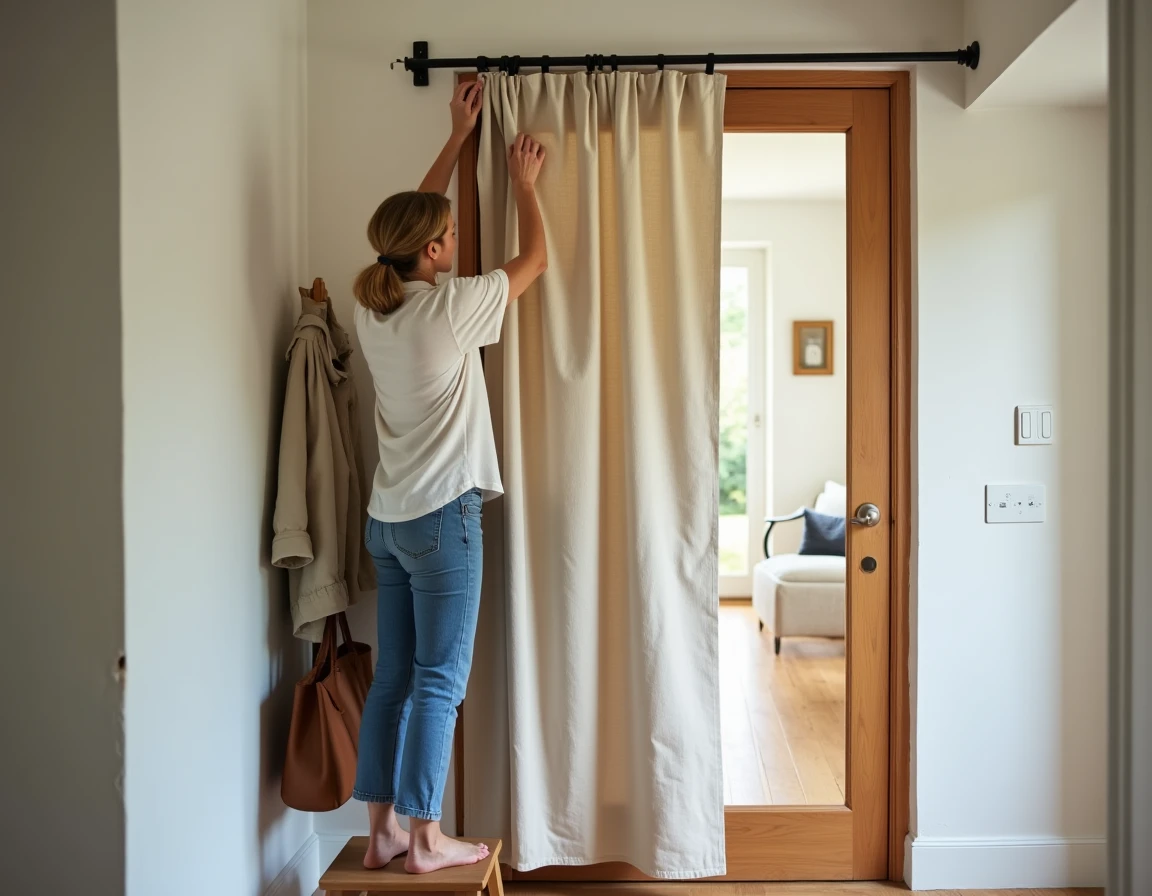
An entrance door curtain acts as a textile barrier between the outside and the inside of the home. Its primary role is thermal: to limit the exchange of cold or hot air at the opening, where the window seals may not always be sufficient. Installation is accessible without special skills, provided you choose the right fixing system and take a few precise measurements before drilling anything.
Fixing the rod to the wall or ceiling: two different installation approaches

Before choosing a fabric or a rod model, the question of the rod’s location determines everything else. Two options stand out clearly depending on the configuration of the entrance door.
The classic wall installation involves screwing supports on either side of the lintel, a few centimeters above the door frame. This method works well when the wall around the opening is wide enough to accommodate the supports without encroaching on a switch or furniture. The rod then extends on both sides, allowing the curtain to fully clear the passage when opened.
Ceiling installation is gaining ground, especially when the door has a bulky handle or a thick panel. By fixing the rod slightly in front of the door, directly to the ceiling, the curtain slides without getting caught in the frame. This configuration also visually frees the lintel and creates an impression of height. Decorators and installers now favor this approach for narrow entries, as the ceiling rod avoids any friction with the carpentry.
Before you start, the detailed method for installing an entrance door curtain is worth consulting to visualize each step of the installation.
Taking measurements for the entrance door curtain without error

The width and height of the curtain are calculated in relation to the opening, not the door itself. A common mistake is to measure the door leaf, while the curtain should cover the entire frame, or even extend beyond it.
- For the width, add a margin on each side of the door frame. This margin allows the curtain to cover the posts and prevent air from passing through the sides.
- For the height, measure from the fixing point (wall or ceiling) to the floor, then subtract one to two centimeters so that the fabric does not drag on the floor.
- If you opt for eyelets, consider the distance between the top of the eyelet and the top of the curtain, which adds a few centimeters above the rod.
A curtain that is too short allows cold air to pass through the bottom, which negates much of the thermal benefit. It is better to plan for a slightly longer length and adjust later with a hem.
Choosing the right thermal fabric and weight for an entrance door
Thermal comfort directly depends on the fabric. A decorative sheer will have no effect on drafts. For an entrance door, the curtain must be dense and heavy enough to create a true barrier.
Curtains labeled “thermal” generally include an insulating lining, often made of fleece or technical material. This lining traps a layer of air between the outer fabric and the door, which slows down temperature exchange. A high-weight fabric with a fleece lining offers the best insulation results.
Thick cotton, velvet, and certain polyester-cotton blends are common choices. Velvet provides a natural weight that keeps the curtain straight, without it lifting at the slightest draft. The blended polyester is more resistant to moisture, a consideration for an entrance door exposed to the elements.
Maintenance and durability of the entrance curtain
An entrance door curtain gets dirty faster than a window curtain. Its proximity to the outside exposes it to dust, water splashes, and frequent contact. Ensure that the chosen fabric can withstand machine washing at moderate temperatures. Thermal linings that are glued may come unstuck after several washes, while sewn linings hold up much better over time.
Fixing without drilling: when and how to consider it
In rental situations or on a fragile wall (thin drywall, soft stone), drilling above the entrance door can be problematic. Several no-drill fixing solutions exist, but not all can support the weight of a thick thermal curtain.
Tension rods (like spring-loaded extendable bars) work in a standard door frame, provided the width remains moderate. Beyond a certain opening, lateral pressure is no longer sufficient, and the rod eventually slips under the weight of the fabric.
High-strength adhesive supports represent an alternative, especially for lightweight rods holding a thin cotton curtain. For a heavy curtain, these fixings quickly show their limits. A DIY tip is to place a hot glue point on the screw head to hold it at the end of the screwdriver during high installations. The glue can be easily removed once the screw is tightened.
Magnetic rods, designed for metal doors, offer a solid and repositionable grip. However, they are limited to steel or aluminum doors, which excludes most wooden or PVC entrance doors.
Fluid passage in daily life: tiebacks and holding systems
An entrance door curtain that must be pushed aside with both hands at every passage quickly becomes annoying. The holding system determines the comfort of daily use much more than the choice of fabric.
Magnetic tiebacks allow you to hold the curtain open against the wall with a simple gesture. They are fixed at hand height and free the passage effortlessly. For a very busy entry, a discreet wall hook with a matching fabric tieback works just as well.
The width of the curtain also plays a role: a curtain cut into two panels that meet in the center opens more easily than a single panel. This configuration facilitates passage while maintaining the insulating effect when the two panels fall over each other.
The entrance door curtain remains one of the simplest additions to improve the thermal comfort of a home, without heavy work or modification of the carpentry. The choice of fixing point and suitable fabric determines both insulation and practicality in daily life.
One last point to check before getting started: the door handle. If it protrudes significantly on the inside, only a forward installation (ceiling or offset supports) will prevent the curtain from catching on each opening.