
Choosing a board game for a night with friends means solving an equation with several variables: number of players, time needed to explain the rules, the group’s tolerance for competition, and whether anyone hasn’t played a board game in years. This article compares these variables to identify the game formats that create the least friction and the most interaction.
Time needed to explain the rules: the factor that can ruin a board game night
Most lists of party games are organized by theme or player count. Yet the most important criterion is rarely highlighted: how long it takes everyone to understand the rules.
A group of six friends, three of whom never play games, will react very differently to a two-minute explanation than to a fifteen-minute tutorial. Casual players lose interest as soon as they feel they’re holding the group back. Semi-cooperative games, where players share a common goal but only one can win, help solve this problem: newcomers can make progress with the group without feeling isolated by an early elimination.
On laminutedejeu.com, game listings include play time and complexity level, two details that let you narrow down your options before buying instead of discovering the problem after opening the box.
Games with rules that fit on a card or can be summed up in one sentence (guess a word, match an image, act out a concept) are the quickest to get reluctant players involved. Games built around successive turns and multiple choices have the opposite effect.
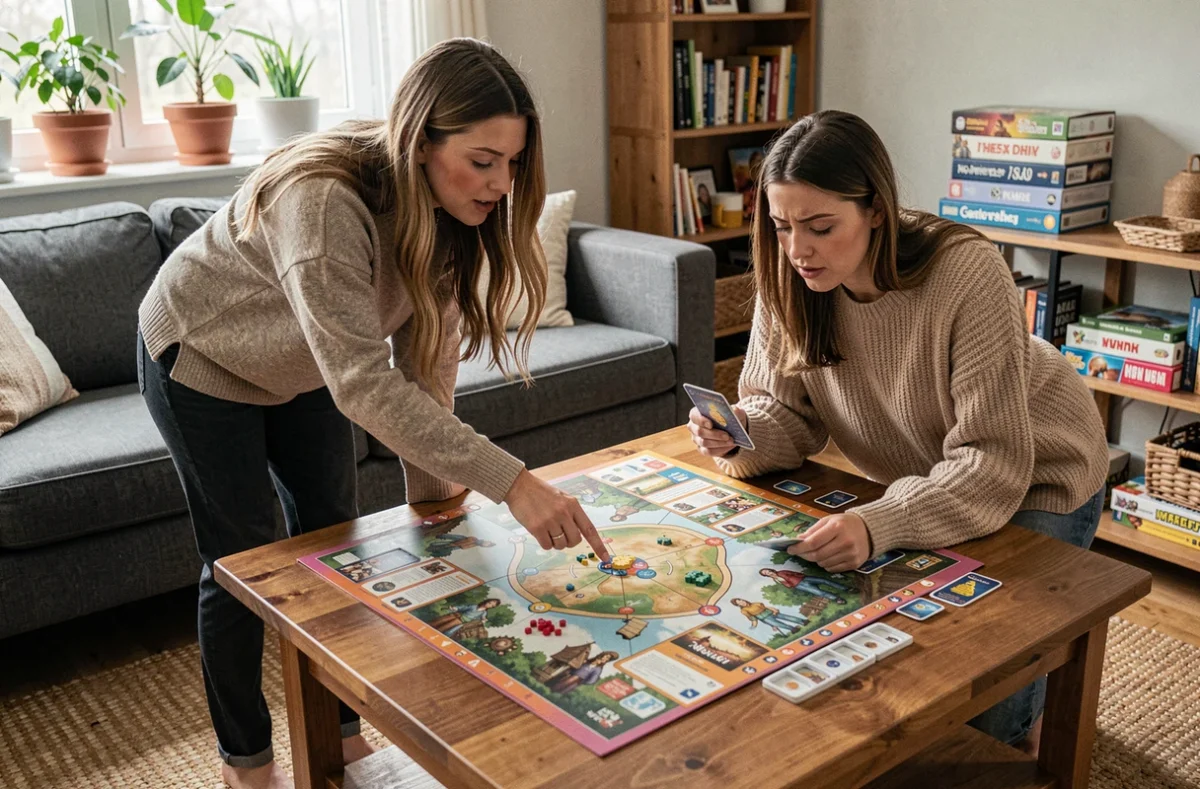
Comparing game formats: players, duration, and accessibility
The table below compares the main board game formats suited to nights with friends across three measurable criteria.
| Game format | Players | Time to explain the rules | Suitable for non-gamers |
|---|---|---|---|
| Party game (word association, guessing games) | 4 to 10+ | Under 2 minutes | Yes |
| Quick card game (shedding, bluffing) | 3 to 8 | 3 to 5 minutes | Yes |
| Semi-cooperative game | 4 to 8 | 5 to 10 minutes | Yes (shared progress) |
| Strategic board game | 2 to 5 | 10 to 20 minutes | No (learning curve) |
| No-equipment game (charades, Werewolf) | 6 to 20+ | Under 2 minutes | Yes |
Party games and no-equipment games accommodate the most players while keeping the barrier to entry low. Strategic board games, despite their depth, have a lower player limit and take longer to explain, which can put mixed groups off.
Party games vs. card games: it depends on the group
Party games (Unanimo, Concept, Dixit) rely on free association. Each player gives an answer at the same time, without waiting for their turn. This simultaneous play eliminates downtime and keeps less invested players engaged.
Quick card games (bluffing, shedding) add a layer of social reading. Players need to pay attention to one another’s decisions, creating tension. On the other hand, a shy player may feel exposed by the bluffing mechanic.
The choice between these two formats depends directly on the makeup of the group:
- A group where most people know each other well can handle bluffing and head-to-head card games, because the reactions are part of the fun
- A mixed group (colleagues, friends of friends, couples getting to know each other) is better off starting with an association or guessing game where nobody loses in front of everyone
- With more than eight people, turn-based games drag on, while simultaneous or team-based formats have the advantage
Team play as a safety net
Splitting the group into teams solves two problems at once. Newcomers can rely on their teammates, and turns stay short because fewer players or teams are taking part. Charades and team-based clue games work especially well with large groups.
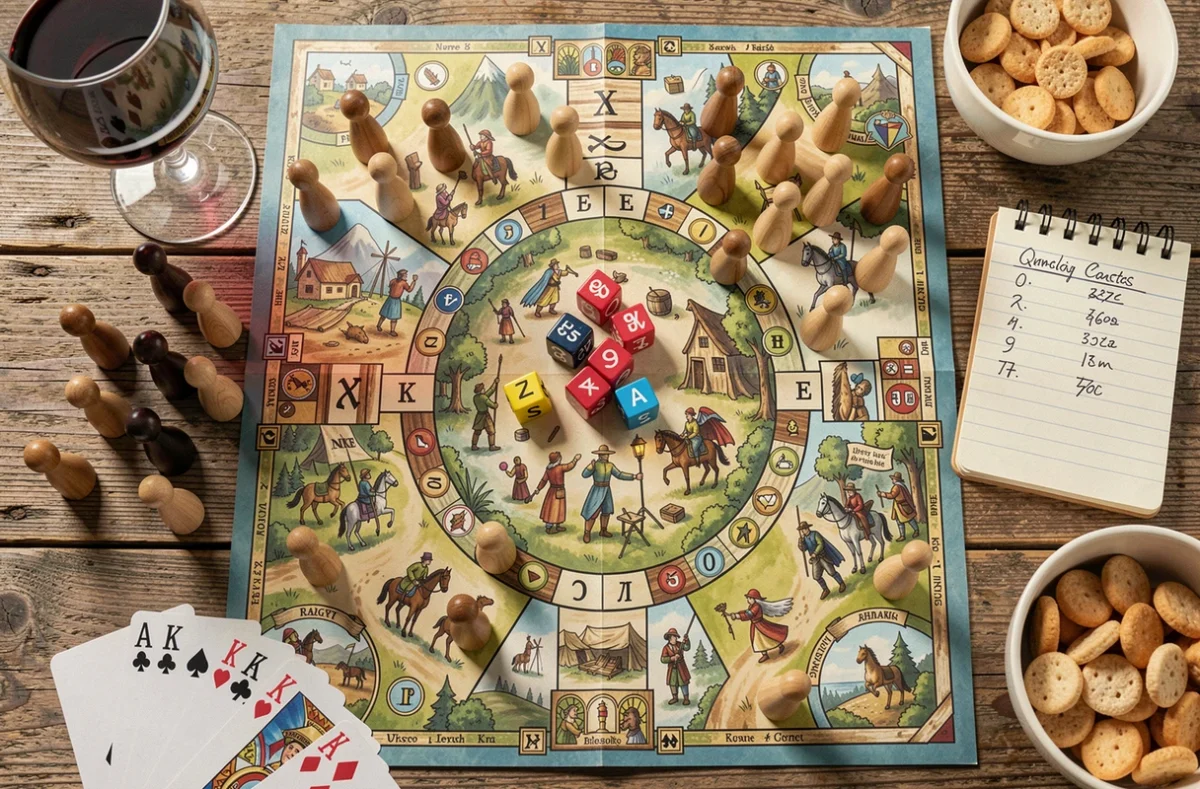
Board game night with friends: build up the pace to keep the energy going
The order of the games matters just as much as the selection. Starting with the simplest game and gradually increasing the complexity helps prevent the group from losing interest and gives non-gamers time to warm up.
Here’s a format that works for a three- to four-hour evening:
- First game (30 minutes): a party game or no-equipment game, with rules that fit in one sentence and everyone playing at the same time
- Second game (45 minutes): a card game or semi-cooperative game, with a little more structure now that everyone has relaxed
- Third game (variable): the group chooses between a longer game or another quick format, depending on how much energy is left
Board game cafés, which are becoming an increasingly popular alternative to traditional nights out among young adults, follow this same progression. Their hosts always start with party games before offering more involved mechanics to anyone who wants them.
The trap of an overly ambitious game late at night
A strategic board game started after midnight rarely gets finished. Even familiar rules become hazy as people lose focus. Successful late-night games have one thing in common: short rounds, immediate results, and the option to stop at any time without frustration.
The number of new releases published in the board game industry each year makes choosing difficult. Rather than chasing the latest release, choosing three games of increasing complexity covers the vast majority of board game night scenarios. A party game to get started, a card game for the main event, and a quick game to wrap things up: this combination works just as well for a group of four as it does for a table of twelve.